
Julia Giles is a visual artist based in Cornwall who uses a range of media including assemblage, found objects, painting, photography, video, and installation.
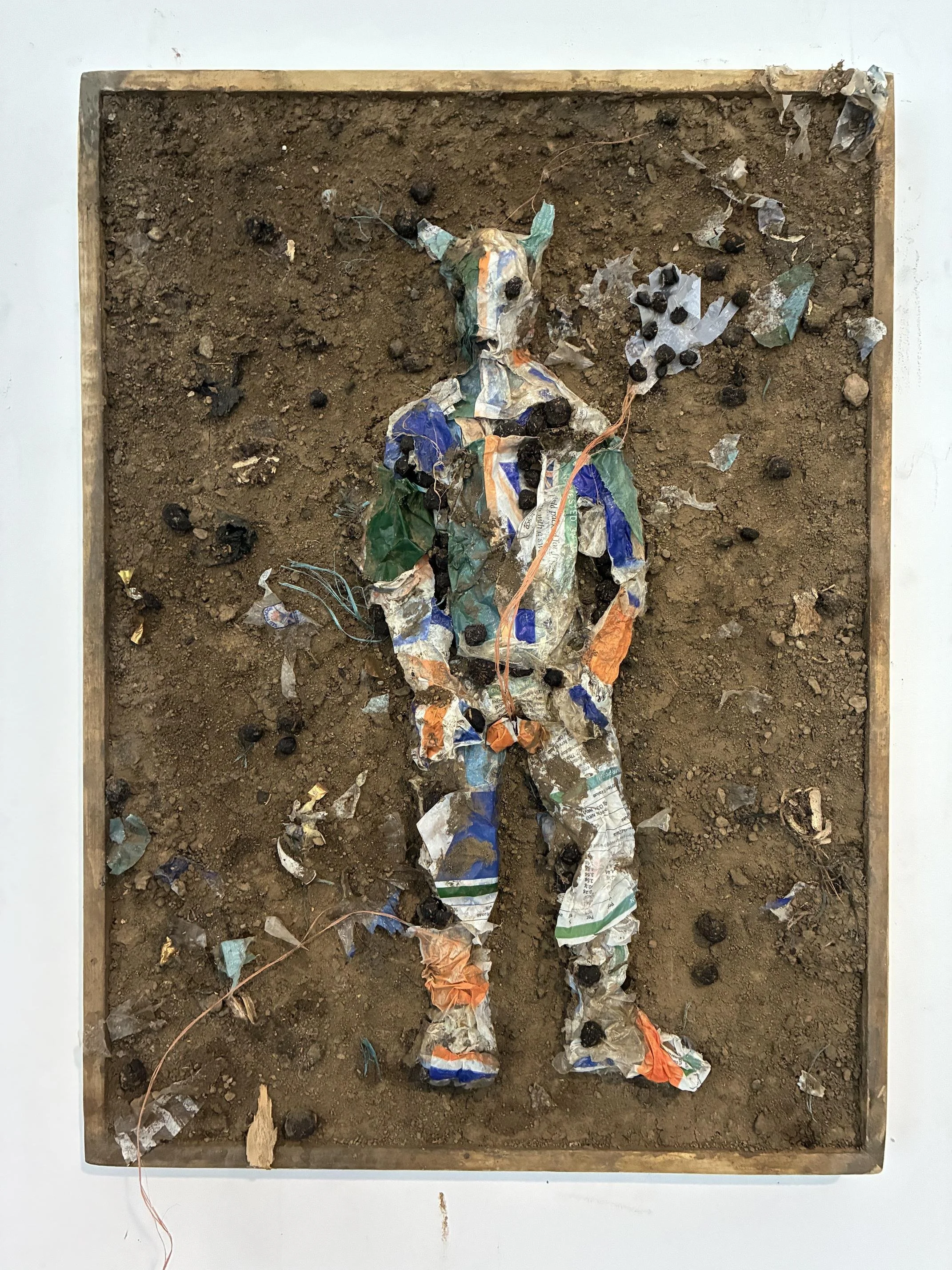
Soil Devil, Julia Giles, Soil, plastic packaging, plastic twine, plant-based fertiliser pellets. 38.5cm x 52.5cm.
Please tell us a bit about your artistic practice.
After years in London, I’ve returned to west Cornwall to live on my family’s farm. I grew up listening to daily discussion about the weather, and its effect on the planting and gathering of crops; my family’s livelihood depended on a predictable seasonal change, and the vagaries of the weather. I think because of this my work has always been about the living land. The focus of my practice now is on the harm we’re causing it.
Was there a particular moment with an animal, landscape, or natural phenomenon that changed the way you think about your practice?
There was no particular moment, just increasing awareness of the impact of climate change and the damage we do to the environment in so many ways.
Please tell us a bit about your current project with poet Katrina Naomi?
I love Katrina’s work and was really chuffed when she suggested working together on a project about the farm. So, she’s been coming over on the bus from Penzance every three months or so, across the seasons, for the last couple of years. We go for a walk to look and listen, and to find things, gathering information and material to work with in response to the land. We then spend some time working separately on starting points for further development. At the end of the day, we share what we’ve been doing. We don’t set out to illustrate or write about each other’s work, but often there’s an overlap in some way. It’s about the land, and the interactions within it, human, animal and plant. We’re hoping to find a publisher for our work. Next year (September 2027) I’ll be having a solo show which will include much of the work we’ve done on the project, during which Katrina will be doing a reading of the poems which started here. I’m really looking forward to seeing & hearing it together as one piece in the same space.
You work across poetry, painting, photography, assemblage, installation, and video. How does interdisciplinarity factor into your relationship with the more-than-human?
I use media that work best to make tangible, or visible, a line of thought that I’ve been exploring. At the moment, making things from found objects feels right. They’re usually a mix of human and not-human things, so in terms of my relationship with the not-human, such a mix can highlight a state of uncomfortable and damaging discord. As with Soil Devil for example.
(‘More-than-human’ doesn’t sit right somehow. I don’t think of them, whatever they are, as ‘more-than’. I’d rather think of them as ‘alongside’, in a symbiotic, interdependent way)
I find it can be quite emotionally taxing to make in response to the land, with the way many governments and corporations have treated nature with so little care. How do you approach (or fend off) this gloom in your practice?
It’s incredibly difficult to fend off gloom - and anger - about this! Finding out about people and organisations that are actively doing something to support the land helps me feel more positive, that change is really possible. A couple of years ago I was lucky enough to take part in a residency with the GroundWork gallery in Norfolk. A highlight was our visit to the 4000acre farm at Wild Ken Hill to learn about their research into regenerative agriculture, and rewilding which includes a 60 acre beaver enclosure. The work they do at Wild Ken Hill is inspiring and definitely fends off gloom for a bit. If I was in charge of our farm, I’d try to follow their example.
Then I think - if such positive change is doable, why isn’t more investment being made...? (I think we all know why) And gloom and anger start to cloud hope again…
I think it also helps to do anything you realistically can. Last summer I staked out 30 small oak saplings ‘planted’ by jays and squirrels on some pasture land. This was to protect them from deer and from being ‘topped’. They’ve come on quite well, despite the drought. I’m going to see if I can stake at least 30 more this year. It’s not much, but it’s something. In time, those trees, if they grow, will provide some shelter for sheep and other animals, birds and insects.
ANIMA/ asks artists to think about the post-, non-, semi- and trans- human animal. What does the word animal mean to you, and where do you see yourself within this category?
I’m just another animal, like everybody else. Ideally, all types of animal live in an interdependent relationship with each other and the ecosystem. But we’re part of a culture that has come to think of itself as outside this and can do what we like with the world’s resources. We’ve become disconnected and have upset the balance. As a species we can be dangerously toxic.
Could you tell us about Soil Devil and how the work came into being?
The idea for Soil Devil was sparked after one of the walks with Katrina. We were making our way across a cabbage field. The crop had mostly been cut. Crushed into the soil were polythene bags dropped by workers during the process of packing the cabbage. These were provided by the supermarkets where the cabbage would be sold. We gathered them up - there were just so many. Plastic in the soil breaks down into micro plastics, is absorbed by the crops and the water system, and end up in the body tissues of animals, including ourselves.
When the cabbage field was being prepared for the next crop (it’s now in maize) the farmer used a fertiliser of plant based organic pellets from his anaerobic digester. Great! But in the soil alongside the pellets were bits of cabbage bags and other agricultural plastics. So, from these contradictory human inputs to the soil, I made a hybrid creature from these opposing materials. Soil Devil is about dual standards when it comes to the environment. I include myself in this. I go on about protecting the soil and nature blah blah blah, but I still use plastic.
If you could gain the power to temporarily transform into the body of any nonhuman being (werewolf-style), what would you choose and why?
I’d be a bird. In late autumn & winter I’d be a crow. I love their calls and the oily iridescent blackness of their feathers. They always seem a bit sinister. In spring & summer I’d morph into a buzzard so I could float high above the ground, riding on the thermals, seeing huge distances. Most of the time in summer and early autumn (when not being a buzzard), I’d be a swallow. They’re so acrobatic and joyful – I’d love to be with them swooping around, chasing each other high and low, getting ready for the journey back to Africa.